 Back
Order & Book
Thrishna Story
Back
Order & Book
Thrishna Story

|
Back
Order & Book
Thrishna Story
|
|
Thrishna and what it means
We are often asked about our business name Thrishna, it has a rich ancient history across many Asian cultures. In current day understanding most know Thrishna as the name of our Bangaldeshi fine food Restaurant in Upton Upon Severn, Worcestershire founded in 2007, attracting many diners from around the UK. The business name was selected for it's original ancient meaning 'Craving' and today 'Desire' and 'Thirst' reflecting the fine food and drink we serve. Here's our 2010 Thrishna logo: 
In Indian culture Thrishna has gained popularity as a feminine name that embodies aspiration. Thrishna (and similar Trishna) have evolved over the millennia from the same Sanskrit root, the original word "trushna" first written down some 3500 years ago. Sanskrit developed as an oral language long before writing, here's an ancient example of written Sanskrit: 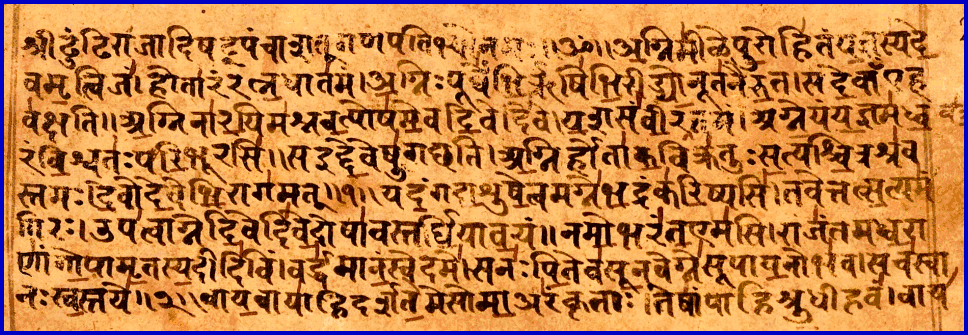
Sanskrit is the original foundation of many Asian languages, each language diverging and individually changing and developing over time within many different cultures. In the following 4 images you can see how 'trushna' written in Sanskrit evolved in Bangla (language of Bangladesh), Hindi (main language of India) and English to be written differently over millennia. In reality three different cultural streams. 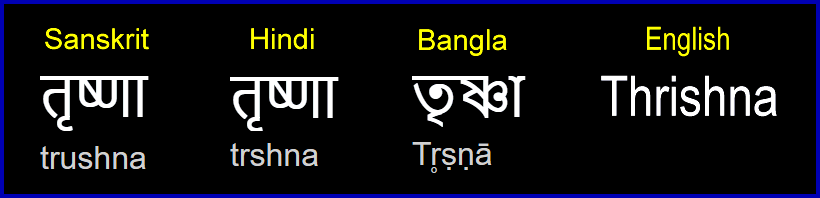
You will see above that Hindi looks the same as Sanskrit, Hindi has retained much of Sanskrit including elements of the alphabet, but there are a range of differences. The word Trishna has evolved a somewhat different interpretation from the Buddhist perspective. It is said to define the cause of sorrow, that is desires not being fulfilled. Ref: The Theosophical Movement Vol.74. One surprising interpretation includes Trishna being said to relate to the word 'vedana' (pain, agony, torture). Ref: Epiphanius Wilson (1900), Sacred Books of the East. The word Trishna appears in the early (1200bc) Hindu Rig Veda which is a collection of ancient hymns, poems and prayers written in Sanskrit. Trishna appears in a few of the included mantras where it refers to greed or hankering.
|